Today, Apple finally releases its biggest new product of 2015 into Irish shops. The smartwatch, which costs from €430 to €13,300, is one of the most hyped products of the year and is being touted as the next big thing in personal computing.
But with only a day's battery life, is it the device to suit your lifestyle? Could waiting for an updated model, possibly released next spring, make more sense?
The Apple Watch, which comes in two sizes, allows you to check messaging notifications, track your health and look for directions using mapping software. Its voice recognition software also works with some apps, such as daily schedules, and it has a limited ability to play music without being wirelessly connected to an iPhone. It is also a key item to pay for things using Apple Pay, an alternative to contactless payment card shopping which has yet to be launched in Ireland.
But some analysts think that an entirely new model could appear next spring as part of Apple's annual hardware upgrade cycle.
If that happens, a new watch could include a Facetime camera for selfies and video calls, more sensors to track health and activity, and even the ability to work independently of an iPhone.
It may even include slightly better battery life, one of the gadget's current limitations.
Like other colour-screen smart watches, the Apple Watch is limited to a single day's usage on a full battery charge, meaning you need to remember to charge it every night.
Despite this limitation, the device has been generally well received by those who have bought one since it went on sale in the US and some European countries earlier this year.
One advantage is its ability to dismiss notifications such as text messages or social networking alerts without having to remove and unlock a phone every few minutes.
And earlier this week, the gadget received an update in its operating system, called OS 2. The updated interface allows more watch faces and apps to be downloaded. It also allows the gadget to perform some online functions without being connected to an iPhone.
For those interested in the device, the decision to buy now or wait until a new model in a few months time will be a personal one.
The watch will likely have a trade-in value, like an iPhone. If you're a jogger or a gadget fan, it makes sense to get one. If not, maybe not.
Apple's new iPhone 6s and iPhone 6s Plus were unveiled at an event on Wednesday in San Francisco. The company revealed details about the innards alongside prices; though as usual skipped finer details like battery capacity and RAM.
Now, a Reddit post claims that the new iPhone models feature 2GB of RAM, in line with several rumours. The post says, "The 6s has 2GB RAM," referring to the iPhone 6s and citing access to internal Apple documents. While the iPhone 6s Plus was not mentioned, both come with an almost identical set of innards.
Similar to previous years, we will have to wait for the handset's teardown to confirm the RAM value. Repair and teardown specialists iFixit had last year claimed that the iPhone 6 and iPhone 6 Plus packed just 1GB of RAM.
A new Apple promo video on YouTube on Thursday hinted that the new iPhone 6s included a 1715mAh built-in lithium-ion battery. To recall, iPhone 6 came with an 1810mAh battery, a fact revealed only after a teardown of the smartphone. While the real world difference is just 95mAh; the company's on its product page capacity claims both iPhone 6 and iPhone 6s offer identical battery backup.
According to Apple, the iPhone 6s offers a talk time of up to 14 hours on 3G and up to 240 hours of standby time. Furthermore, the handset is listed to deliver an Internet usage time of up to 10 hours on 3G and up to 11 hours on Wi-Fi. The iPhone 6s can offer HD video playback time of up to 11 hours and audio playback of up to 50 hours. All the above claimed figures are same as the iPhone 6.
Separately on Thursday, Adobe in a blog post detailed its latest products for mobile devices including the name of the Project Rigel app - Photoshop Fix. In the post, the company had noted that the iPad Pro comes with 4GB RAM; though it soon pulled it down.
The price for the new iPhone 6s and iPhone 6s Plus remain unchanged compared to their predecessors at launch. The iPhone 6s 16GB will be available at $649 (approximately Rs. 43,000); $749 (approximately Rs. 50,000) for the 64GB, and $849 (approximately Rs. 56,500) for 128GB model. The iPhone 6s Plus will be available at a starting price of $749 for the 16GB model, $849 for the 32GB model, and $949 (approximately Rs. 63,000)for the 128GB iPhone 6s Plus (all US prices).
If you've been wanting to see the two high-end Windows phones Microsoft has been developing, then you don't have to wait until the official launch. Evleaks has posted the renders for both devices on Twitter: the larger, cyan one with a 5.7-inch screen is known as codename Cityman, while the black phone with a 5.2-inch screen is Talkman. They're expected to have Quad HD displays, 3GB of RAM, 32GB of internal storage and 5-megapixel front shooters. Cityman might be powered by an eight-core chip, while its smaller sibling might be equipped with a six-core processor.
According to The Verge, they might also support USB Type-C as well as Qi wireless charging. Evleaks tweeted out the renders as a response to another image showing a Cityman connected to a peripheral that will allow it to support Microsoft's new Continuum feature. Based on what we've seen earlier this year, Continuum can turn phones into teensy Windows computers. These devices could be launched at an upcoming Microsoft event this October -- we'll keep you updated with all the pertinent info, especially when you'll be able to buy them.
We seem to be living in a golden age of robotics and artificial intelligence. These days, we can’t even go a few weeks without hearing about some wild new advancement that brings the notion of futuristic and intelligent robots that much closer to reality. Of course, at the same time, each new advancement also brings with it a certain level of fear, a point driven home by Tesla CEO Elon Musk who said that exceedingly advanced AI can be fundamentally dangerous.
Case in point: researchers at the University of Cambridge recently developed an intelligent robot capable of having children. Which is to say, the robot was programmed to assemble smaller robots and can even monitor the progress of its creations as to improve the building process in subsequent builds. All the more impressive, this is all done without any human intervention or external computer simulations.
DON’T MISS:I just watched my smartphone case heal itself from scratches
“The blocks are assembled into a structure by the robot arm, and the motors are turned on,” CNBC explained in a report. “A camera detects how far the blocks are able to travel. The robot arm sees this, and then modifies the next “baby” to try to make it go further, learning from the mistakes and good traits of the last one.”
“Machines usually build the same thing and what it will do and it will do it over again,” one of the researchers explained. “What we did here was use a genetic algorithm so each operation is different,”
So while this advancement is breathtakingly cool, it’s also somewhat jarring.
The biggest new feature believed to be in the pipeline for the iPhone 7 is the introduction of Force Touch, which is likely to have particular benefits for business users. First developed for the Apple Watch, Force Touch is a pressure-sensitive touchscreen that can distinguish between a light touch and a longer, heavier press, and react differently to each. For example, a light tap on an email will open it for reading, while heavier pressure will launch the reply screen. When this is applied across the operating system, and in productivity apps, it is likely that business users will be able to accomplish many of their regular tasks more quickly and with fewer steps. Bloomberg reports that an iPhone 7 equipped with Force Touch entered "early production" at the beginning of July.
iPhone 7 battery life
Battery life remains an Apple weak spot, and early reports about the iPhone 7 bring mixed news. Business users in particular tend to hammer their batteries, often while travelling and with unpredictable access to power sources. For them, the improved power efficiency that comes with the A9 chip won't go amiss, but nor will it provide the step change that many will have been hoping for. That would require an increase in battery capacity, which Apple seems unlikely to provide. In an interview with the Financial Times earlier this year, Ive all but ruled out compromising the aesthetics of the iPhone 6S or 7 in order to accommodate a bigger power pack. "When the issue of the frequent need to recharge the iPhone is raised," the FT says, "[Ive] answers that it's because it's so light and thin that we use it so much and therefore deplete the battery. With a bigger battery it would be heavier, more cumbersome, less 'compelling'." Business users might retort that it’s the pressing nature of their work rather than the beguiling slimness of the iPhone that leads them to check their emails, but it seems that their protests will not be heard.
Software upgrade
Apple has already released a test version of its next operating system, iOS 9, which is expected to go live when the iPhone 7 is released this autumn. It will bring with it a range of improvements likely to make the lives of power users a little bit easier, including, according to Apple's VP of software engineering, "a redesigned Notes app [that] provides great new ways to capture ideas". It is also intended to improve power management and therefore battery life – another sign that Apple is attempting to solve this problem through better use of available power rather than increased batter capacity.
Dynamic home button
The first iPhone transformed the way we interacted with smartphones, introducing the now-standard pinch to zoom and swipe to unlock gestures. According to Business Insider, the iPhone 7 could add more gestures to its arsenal, further increasing efficiency and multi-tasking capabilities. It examines a patent filed by Apple which "details an iOS home button capable of detecting various gestures along with the force of each touch. In other words, imagine Force Touch, albeit applied to the home button as opposed to the device's display."
Better front-facing camera
Although it is often dismisses as a selfie-cam, a phone's front-facing camera can be a useful business tool too – and clues embedded deep in Apple's new operating system suggest that it will get a big upgrade on the iPhone 7. Macworld reports that camera resolution will increase from 1280x960 to 1920x1080, which means that Skype and Facetime conversations with colleagues and clients will be sharper and smoother. The same source suggests that it will also be capable of recording slow-motion video, and come with a flash, but those new features are perhaps of less interest to business users.
iPhone 7 performance upgrade
The iPhone 7 will come with a new processor, likely to be called the A9, which will bring improved performance. TechRadar says the new chip will be "15% smaller, 20% more powerful and 35% more power efficient than the Apple A8 processor found in the iPhone 6 and iPhone 6 Plus". The increased speed will, as ever, be welcome, but for many the improved power-management will be the more useful development…
iPad upgrade
iOS 9 will also been pushed to the iPad, on which it will enable some potentially significant productivity gains. As well as improvements to the mapping app, it will also enable split screen multi-tasking, allowing you to run more than one app at once and switch seamlessly between the two. The new operating system will also introduce a new keypad for the iPhone, designed to make long-form text input more efficient.
Instruction is imperative at all the levels. It is the thing that develops each youngster into an achiever later on doing what he or she is best in and loves doing. In as much as the hypothesis classes are critical in guaranteeing that the youngsters get the ideas of what they are realizing, it turns out to be significantly less demanding for them when they can see models of what they are realizing or get the opportunity to put into practice what they have learnt in class through investigations or handy classes. It is thus that schools have science labs, material science lab and even science labs and PC labs. They are all planned to help them put into practice what they have learnt.
The Problem
Sadly, not all youngsters become acquainted with the offices that they have to make learning complete. This is can be as an aftereffect of a school being excessively remote and in a poor setting without the hardware that is expected to open the potential outcomes for the youthful ones. Creating nations or underdeveloped nations additionally think that it difficult to connect with every one of the schools particularly those in remote ranges. This implies that while a few kids have each educative material that they have to make adapting high in quality, some pass up a great opportunity for this. They are ravenous for training, however there is no chance to get out for them.
From such shocking gatherings, the science masters expected to discover world answers for diverse issues or the specialists that will concoct cures for probably the most destructive infections could come. When they need legitimate instruction along these lines, what's to come is bargained. Science and innovation is essentially what the world needs to grow significantly further and it can have an entire effect even in creating nations. Aside from making it feasible for the youngsters to take care they could call their own issues, science and innovation makes it workable for them to tackle group issues and even world issues. The future unquestionably lies in the hands of the minimal ones and everything should be done to secure it.
A piece of the Solution
Contacting the less lucky nations, schools and to the meriting kids is a piece of the science and innovation arrangement that is expected to take the world higher. Through non-benefit associations committed to verifying that kids get a training and quality instruction besides, you can now stretch out science and innovation to the individuals who need but require it the most. The gifts can be as life structures models, magnifying instruments, portable workstations and PCs, material science packs, science sets, cosmology gear and models and also other general school science hardware.
The hardware can be purchased and gave to the associations. You can likewise give out old hardware you have, for example, PCs and portable workstations for the instruction of the youngsters in the remote schools. They give them the hands-on encounters they require when learning and this effortlessly makes it simple for them to identify with what they have realized and even think of awesome thoughts that can change the world.
If you're organizing luggage for any lengthy trek then completely you'll be a lengthy way in the mains energy for a few days. Furthermore, all of us are knowledgeable about the ultimate fact of Smartphone's as well as other flexible battery gloating gadget continues for a few hrs or practically a single day, only that. Within this lengthy outing, energy bank ordinarily is within every way very significant. This is actually the place the useful USB Charger for Apple ipod device allow you to keep the gadget battery at its legitimate line, helping you to keep in touch together with your dear ones and furthermore holding you back enamored with packs of built-in programs.
Essentially ipod device Shuffle, that is greatly used to obtain the impossible music fun could be stored accusing constantly with this minimal lightweight beneficial USB port cable. Using the colossal revolution within the technology, step-by-step devices are now being reduced within their size with comparable or considerably even more effective property and effectiveness. In addition, because the size decreases, its cost likewise an increment piece by piece. One particular gadget which has destroyed the utilization and accessibility to pocket Audio players may be the Apple ipod device Shuffle including 10 occasions bigger storing the boundaries from the data and conferring durable battery existence.
Hello and welcome to our science and technology news weekly round up! The purpose of this segment is to look back at the past week and see what’s been happening in the wonderful world of science and technology. We won’t be discussing anything at length here since we already covered all these news stories. Rather, we’re making a short summary and will include some of the most important, interesting, or just downright strange stories of this past week. Down below you will be able to read about fascinating subjects such as NASA’s Avengers-like initiative, robots buying drugs, ultra-fast MagLev trains, breakthroughs in cancer researches, and of course, the 25th anniversary of the Hubble Space Telescope. I’m also cheating just a little bit this week by including something that’s not news per say, but that you might find interesting nevertheless. Let’s just call it a little bonus and just leave it at that.
Inside a lobby at Google’s headquarters in Mountain View, California, beside
a rank of 1990s arcade machines, a laminated sign asks people to “Please Be
Googley”. It is a request that visitors remember to wear security badges; also
that they don’t steal any of the stuff that’s been left around for staff
enjoyment – pedal bikes, sombreros, electric guitars. Employees at this £250bn
company get stock options as a basic condition of employment. Wacky office
furnishings, too. Upstairs in what Google calls its people operations department
– human resources – there’s a climbing frame. A gym machine. Most sit at desks,
today, frowning and purposeful, but one young staffer has taken a laptop to an
indoor picnic table, next to the hammock.
In his office, Laszlo Bock, head of people operations, handles the claims
from outsiders asking: “Please let me be Googley.” Each year, around 2
million apply for a job here and 5,000 are hired. Bock puts the average
applicant’s odds at about 400/1. On a wall he keeps a small display of some of
the worst (Bock prefers “silliest”) submissions that have come in. People try to
grease him, impress him, plead with him, threaten him. He was offered, once, a
discount on a motorhome in return for an offer. And somebody mailed in a shoe;
with this foot-in-the-door joke the hope, presumably, that an acceptance letter
would be sent by return post.
Bock is 43, big-jawed, handsome, once an extra on Baywatch and still with the
straight-backed bearing of a screen lifeguard. He joined Google six years ago,
when the brand was on its evolution from agreeable little search engine to
terrifyingly ambitious everything-engine: email, maps, operating
systems, phones, soon a phone network. Six years ago the company had 6,000 staff
and now it is 50,000-strong – “the size of a respectable city,” as Bock points
out, one made up of engineers, designers, marketers, lawyers, administrators,
chefs and many of their dogs, who are welcome on site. If founders Larry Page
and Sergey Brin settled this city, and executive chairman Eric Schmidt serves as
mayor, then Bock is something like its immigration chief: roaming the border in
a dune buggy, binoculars across the landscape, considering bids for entry. Keeping on target… arcade games on Google campus at
Mountain View HQ, California. Photograph: Winni Wintermeyer
“I was buying a lottery ticket once,” he tells me. “My brother said to me,
‘I’m not buying a lottery ticket. And my odds are almost the same as
yours.’” He means: getting a job here is hard. “It’s not hopeless, though.” Bock
will soon publish a book, Work Rules, in
which he reveals some secrets about how Google identifies people it wants and
how it spoils them once they’re in. Fortune magazine has ranked Google its No 1
most desirable place to work for six years in a row, citing as one reason a new
policy of distributing “baby bonding bucks” to staff. Had a kid? Have $500. This
is the kind of thing they do.
I sit with Bock on easy chairs in his office. He is used to assessing
strangers in this room and I ask him to give me the once-over. First impression
stuff. Would I be cut out for Google?
He stares for a moment and says: “Well, first impressions, OK. British
accent, tall, slender.” He gestures at my trainers. “You’ve got your tongue out
on top of the laces knot. Which actually solves an important problem for me,
because it always looks awful the other way, with the knot out, and now I know
the answer.” He scans my face. “You’ve got the funky glasses but not, like,
super funky. So you’re not highly affected…” He says I seem nice
enough. “But stepping back from that, if I were considering you from a Google
perspective? At this point I would conclude I know nothing about you. I haven’t
been able to assess any of the things we care about yet.”
What are the things you care about? Volleyball on Google campus. Photograph: Winni
Wintermeyer
“Four things.” He lists them, in order of importance. First, “general
cognitive ability… Not just raw [intelligence] but the ability to absorb
information.” Second, “emergent leadership. The idea there being that when you
see a problem, you step in and try to address it. Then you step out when you’re
no longer needed. That willingness to give up power is really important.” The
third thing, Bock says, “is cultural fit – we call it ‘Googleyness’ – but it
boils down to intellectual humility.” He says you don’t have to be nice. “Or
warm, or fuzzy. You just have to be somebody who, when the facts show you’re
wrong, can say that.” And fourth? “Expertise in the job we’re gonna hire you
for.”
That comes last? “If you can do the other things, not only most of the time
will you figure out the job, you might come up with a novel way of doing it
nobody else has done before.”
In Work Rules, Bock itemises staff privileges, some famous, some lesser
known. There’s the subsidised childcare, the dogsitting, the massage chairs.
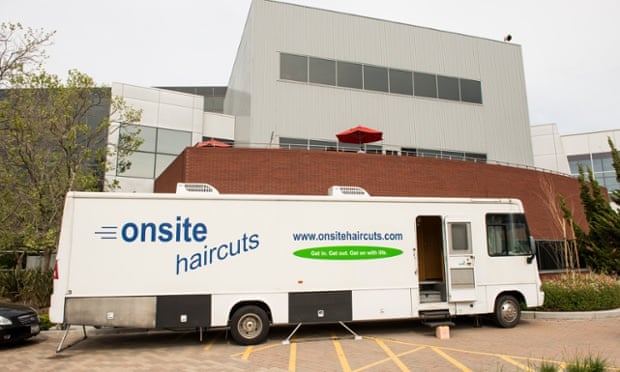
Hairdressers visit the site every Monday and mechanics come to service cars on a
Tuesday. With a few clicks on the local intranet, employees can arrange, without
management’s approval or knowledge, surprise bonuses of $175 for each other –
just because. Should they die, and should they be married, their spouses go on
receiving half their salary for a decade. Two square meals a day. Free
ice-cream!
Assuming the outsider can still think for envy, reading this, they might
wonder if Google ever wants its people to leave the site. Whether this is
gilded-cage stuff. In conversation with me as well as in his book, Bock argues
fiercely against the suggestion. “Google isn’t some sweetly baited trap designed
to trick people,” he writes. He tells me he has no particular interest in how
long employees hang around. “If you’re doing good work and getting it done, I
don’t understand why I would care what hours you work.”
So the nine-to-five, that totem of work culture – bullshit? “Totally,” Bock
says. “Fundamental premise: people are good and want to do good work. I don’t
care how and when and where.”
***
Bock’s book also has one of those ambiguous titles beloved in business
literature. Work Rules: I read three meanings into it. Here are some rules for
work. Here is something you might shout, delightedly, in an office that has a
climbing frame. And here’s a thorny modern truth – that work rules us now in a
way it has not done before. “You spend more time working than doing anything
else in life. It’s not right that the experience,” Bock writes, “should be so
demotivating and dehumanising.” He suggests rival companies might like to adopt
some of Google’s policies.
Flicking through the book, I keep imagining a CEO at a lesser firm doing the
same, digesting Bock’s tips as to how to ensnare the world’s A-graders and
90th-percentile types. Having a Google executive explain how to attract
desirables must be a little like having a part-time-modelling doctor pal (who
can cook) advise you on how to be more magnetic. But Bock writes well, and in
his book he opens the curtains a little wider than before on this corporation,
in control of so much of contemporary life, always insisting on its own
transparency even while the core company is sequestered away in a remote HQ. Taking a break. Photograph: Winni Wintermeyer
I take a bike ride across the Mountain View site, guided by a volunteer
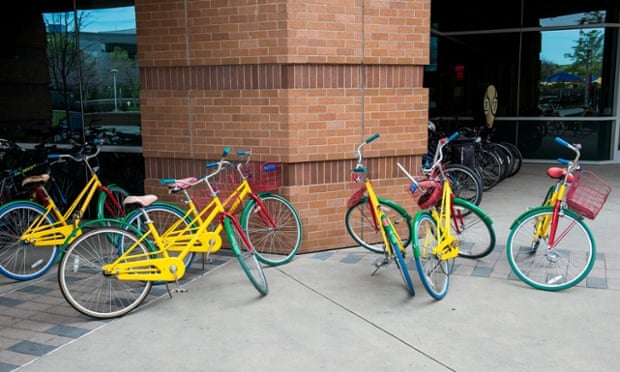
staffer. It’s a warm day. On a pair of brightly painted Google-bikes, left about
for free use, we cycle by a fire station, a music venue, an adjoining airfield
that Google recently took on so that its fleet of driverless cars could whizz
about, unshackled. They call the whole site “the Googleplex” but if, like me,
you find that hard to stomach, the natives will also settle for “the Google
campus”. I ask the staff member why the streets have such boring names –
Crittenden Lane, Charleston Road… Were this Apple they would long ago have been
rechristened Solution Way, Future Avenue. “We don’t own the land,” she says, “so
we don’t name the roads.”
Google moved into Mountain View around 15 years ago. A small town off Highway
101, around 40 miles south of San Francisco, it was once dominated by almond
farms. No longer. I’m told Google hasn’t put up a building here, they’ve only
occupied more already in place. But the company has “kind of outgrown our
real-estate footprint”, in Bock’s words, and large-scale expansion plans were
recently submitted to Mountain View’s local council. As it stands today the town
is still sleepy, peaceful, blandly pretty. We prop up our bikes beside a water
feature and when a line of ducks trots by, the staffer says: “Prop animals.”
This lot know how we see them. Warily, wearily. Dave Eggers’s 2013 novel The
Circle, a Nineteen Eighty-Four for the online age, imagined a cult-like tech
firm, one whose innovations increased a sense of social surveillance. Apparent
similarities between Eggers’s fictional company and Google were noted, and I
expect to learn that the novel would be a no-no on site. My tour guide tells me
she remembers the book being hotly discussed in campus cafeterias. (We agree
that I won’t name her.) Everybody seemed to have read it and nobody, as far as
she knows, was offended. Space to think on Google campus. Photograph: Winni
Wintermeyer
We continue our tour on foot, going by the building that has a two-lane
bowling alley, a climbing wall. I’m encouraged to pick from a flourishing
strawberry plant. Across the way people play volleyball, some of them in
Google-branded leisurewear. I look out for signs that the place is a pressurised
hothouse for its employees; a sort of prison with soft-play walls. I don’t see
it. People walk around unhurried, holding laptops and water bottles, holographic
security badges thwapping against their thighs. On a deckchair in the herb
garden, an employee sunbathes. One guy whirrs by on an electric skateboard.
I ask my guide, who is wearing a summer dress, if she’d ever come to work in
a Google T-shirt. She gives me a long look and says: “Only if I had no other
clean clothes.”
Millions want to work here – but not everybody does. I expect the biggest
challenge for outsiders who were at all cynical, or self-reliant, would be the
daily grapple with Google’s institutional devotion to zaniness. In Work Rules,
Bock mentions unicycling clubs, juggling clubs, the tireless nicknaming, with
“Googler”, an umbrella term for employees, broken down into “Noogler” for new
arrivals, “Graygler” for older hands, “Jewgler”, “Gaygler”. You cannot be on
site long before hearing about the weekly all-staff meetings. They’re called
TGIFs, or Thank-God-It’s-Fridays. And they’re staged on Thursdays!
But there is a more knowing humour beneath the panto. When I tell Bock about
my efforts to get inside the building on arrival – how, as I pawed at a locked
door, a polite boy in shorts interrupted to direct me to one of the lobbies –
Bock says: “Most people don’t know this. But that guy? Trained killer. Had you
tried to penetrate further that would’ve been it for you.” He carries on,
poker-faced, about the number of visiting parents and grandparents who’ve been
reluctantly assassinated this way…
Bock enjoys the riff and so do I. Afterwards a press officer leans in to
clarify, “No grandmas get whacked at Google.”
***
The press officer’s name is Meghan Casserly. Her hiring was a telling example
of the company’s privileged, take-charge policy on recruitment. Bock writes in
Work Rules that, far from sending in emails, or shoes, Google doesn’t really
want you to approach them. “The odds of hiring a great person based on inbound
applications are low,” he writes. Preferred is the scout, the long stalk. He
tells me the recruiting corps at Google might eye a target for years. “And then,
y’know, when they’re having a bad day – that’s when we strike. I’m joking a
little bit. But we want to be there at those moments, when someone’s like, ‘You
know what? I love what I’m doing but now’s the time to try something
different.’” The on-site hairdressing van. Photograph: Winni
Wintermeyer
In 2012 Casserly was a journalist at Forbes, assigned to interview Bock.
During their chat he let slip about those preposterous death benefits, not yet
made public by the company. (As well as the half-the-salary thing, Google
immediately pays out the value of any unvested stock to an employee’s bereaved
partner. It then contributes $1,000 a month for any children until they come of
age.) Casserly wrote up the story with the headline, “Here’s What Happens To
Google Employees When They Die.” A big scoop.
“We thought, man, she’s fantastic,” recalls Bock. His team approached
Casserly about a job in the press office and she agreed to apply, she tells me,
only because she thought she might write another article about it. Her editor at
Forbes was in on the plan. Then, she says, the conversations with Google got
“cooler and cooler. And the money was… interesting.” She joined about a year
ago, a graduate, recently, from her “Noogler” status. She sits in on my
conversation with Bock and monitors for indiscretions. At one point she
instructs him, “Stop saying cult!”
Bock and I have been talking about some of the negative perceptions of
Google. That it’s cult-like. That it’s smug. Perceptions, I should say, his book
won’t do an awful lot to dissuade. As early as the first page, he compares
founders Page and Brin to Romulus and Remus; also to Thomas Edison, Oprah
Winfrey and Superman. Bock says he’s aware that internal zeal may not scan well
from the outside. He jokes: “One of the defining elements of any cult is that
from the outside it totally looks like a cult, and from the inside everyone
denies it’s a cult.”
Google, he knows, can appear shut away. “Hermetically sealed. For example we
don’t have many leaks for a company of our size.” He insists the vibe from
within is more mutinous. “There’s this roiling, constant debate and argument and
fighting. Because we do have people who represent all kinds of different
perspectives – we even have luddites who think technology’s ruining the world.
Debate is part of the fabric of who we are.” He looks at Casserly, an apology
before using the forbidden word again. “You become cult-like when you
have a single set of beliefs and you say, ‘This is the answer and you’re not
allowed to question that.’ Not the case here.”
What about the smugness? Google’s assumption, in both of the word’s
senses, can be staggering. The public backlash against those early-adopters who
started wearing Google Glass spectacles a year ago – “Glass-holes” – might be
seen as a manifestation of a larger frustration with the company and its seizure
of ubiquity, its creep into positions of ever greater influence. (In this world
and beyond: the company will soon send up drones to blip back Wi-Fi from lower
space.) Many are upset by Google’s squinty position on internet censorship in
China, interpreting it as complicity with an oppressive government. In the US
there have been significant government investigations into anticompetitive
practices at Google, since wound down, though not before damning accusations
were made. A similar inquiry launched by the European commission goes on.
Publicly, I think, unease was most palpable when an armada of Google’s
camera-equipped Subaru cars, touring the world and taking photos to prettify its
map service, turned out to be absorbing data from people’s personal Wi-Fi
accounts en route. “So how did this happen?” Google commented in a blogpost from
2010. “Quite simply, it was a mistake.” The chummy non-apology was tin-eared.
Experts wondered about that “mistake”, pointing out that Subarus don’t teach
themselves to plunder private data. In 2012 Wired published an article about the
fiasco that it headlined “An Intentional Mistake”.
Bock: “From a perception perspective, I mean, look – we haven’t been as good
as we ought to be in meeting with different communities outside of Google that
care deeply about what we do. If you look at privacy… we haven’t done as good or
thoughtful a job of having those conversations [as we might have]. We’re getting
better. But we haven’t done as good a job [as we might have] on that.” He admits
that Google sometimes gets stuff wrong. “I think there’s a lot of perceptions.
And some of them are of our own making.”
What does he mean by that?
“There’s a lot of responsibility that comes with having a global brand, and
the kind of footprint we have, and the kind of impact we have, and we need to
live up to that. And, by the way,” he adds, veering back to the smugness issue,
“we hire people who are very high IQ. Not very high EQ.”
Sharp but not emotionally sharp, he means. I’m surprised to hear him
acknowledge this. It would explain a lot. Bock says: “We don’t always realise
how some of our folks come across. By and large, it’s very well intentioned. So
from the outside, yeah, I absolutely see that we need to get better, and work to
change the perception, and make it more in line with how Googlers see
themselves. But even inside, yeah, there are some people who are smug. They’re a
minority.” Google bikes. Photograph: Winni Wintermeyer
He writes in his book about “a small but odious segment of Googlers” who,
among other internal misdemeanours, have abused the free meals system. Everyone
eats for nothing here. Bock has caught people stashing takeaway boxes in their
cars, pinching handfuls of granola bars for weekend hiking trips. Not long ago
there was a campaign of resistance against Meatless Mondays, Google’s practice
of offering only vegetarian meals once a week. In a chapter called It’s Not All
Unicorns And Rainbows, Bock recounts the protest barbecues and silverware thrown
away in anger. He quotes an email sent to him by a campaigner. “Stop trying to
tell me how to live my life… Seriously stop this shit or I’ll go to Microsoft,
Twitter or Facebook where they don’t fuck with us.”
Bock means for us to be shocked by this but I find it gratifying to know that
in among all the super-people, a little corps of the sub par have snuck in.
Fuck-Youglers, I call them.
I ask him, when they reveal themselves, these bad’uns, does he feel he’s
failed as a recruiter? “Yeah. Everyone makes mistakes and we do, too. So you
hire some people who are jerks.”
***
Back to that 400/1 chance for new applicants. I speak to a bookmaker at
William Hill who offers me only slightly longer odds, 500/1, on my becoming
prime minister. What can hopefuls do to improve their appalling chances of a job
at Google?
Try to compete in at least one Olympic Games. (There are half a dozen former
Olympians on the books.) Win an Academy Award or a Turing award. (Google has
these, too.) Bock reveals that there’s no point brushing up on clever-clever
logic questions, brainteasers about things like tennis balls in swimming pools,
because they’ve done away with that in interviews. The company once plastered a
giant maths equation on a billboard and invited anyone who could solve it to
apply, but no hires resulted. These days he puts greater trust in the blunt, 2D
question. Tell me about a problem you’ve solved, tell me about a time you’ve
squabbled with a colleague.
Never tick off Larry Page. Even though this is now a city-sized operation,
Page still enjoys the final say on every newcomer. How often can it happen, that
an applicant gets all the way to the gates only to be barred by Romulus himself?
Bock says once in a while. “A lot less than five or 10 years ago. Then it would
be a weekly thing: ‘Not this one, not that one.’ Because what he was doing was
calibrating all of us, saying: ‘This is what truly great looks like.’”
Who knows, Google might come and get me after this. I catch Bock looking on
approvingly while I snoop around his office, making notes about the climbing
frame and the (vast) coffee selection. I appear to score big points for
suggesting that those generous death benefits must, in the end, make it more
likely for a Googler’s partner to murder them. (“That was pointed out
internally.”) And there was the impressive thing I’d done with my shoelaces.
If a call comes, the chances of acceptance here soar – to about 1/100. For
any open position, Google will be interrogating 100 people simultaneously. After
six weeks of this, 99 are rejected. They’re not told why. “If somebody just
breaks up with you,” Bock says, “that’s not the time to hear: ‘And really, next
time, send more flowers’… For the most part people actually aren’t excited to
get that feedback, because they really wanted the job. They argue. They’re not
in a place where they can learn.”
So what happens?
“We just say, ‘Congratulations, you’re hired.’ Or, ‘Sorry, it didn’t work
out. Please apply again.’”
As Apple’s chief executive, Tim Cook, prepares to reveal the few details not
yet known about the Apple Watch – the price, the battery life, when it will hit
the shops – some are already predicting a flop.
It will weigh the company down, they argue, and the solid gold version aimed
at the very rich will tarnish a brand that promises “affordable luxury”, turning
it into the preserve of rich fashionistas who wouldn’t be seen dead with last
season’s $2,000 handbag – or $5,000 smartwatch.
“Apple needs a new product to reduce its reliance on one core product, the
iPhone,” David Goldman, CNN’s technology editor, said in February. “It won’t
find that with the Apple Watch.”
At a mooted starting price of $350, he argues, it’s pricey – but not truly
beautiful, uncompelling and, in any event, likely to be updated in a year.
In fact, that $350 price tag makes it the cheapest new category Apple has
ever introduced – the original iPod, in 2001, was $399. (There was the $299
Apple TV set-top box, but that was always something of an
afterthought.)
But the watch has also seen an intensive PR and marketing effort, including
recent lengthy interviews with head designer (and Briton) Sir Jony Ive in the
New Yorker and the FT’s How To Spend It section (in which he
murmurs that the watch is “clearly the most personal product we’ve ever made”),
and a 12-page set of ads in the March edition of Vogue at an estimated cost of
$2.2m.
It connects to an iPhone, and displays – or taps your wrist with
notifications from – apps about all sorts of things (sparking a new goldrush).
It’s watch-like, but more of an extension to a phone. Doubters have focused on
the battery life (about a day); enthusiasts on its potential to save you pulling
your phone out of your pocket for maps or train times.
The launch of the watch isn’t the first time Cook has faced doubters. In
spring 2013 there were calls for his head when Apple’s market capitalisation was
$366bn, far below an earlier peak of $658bn in September 2012. Now it has passed
$750bn, Cook is still in place, new products are on the way, and analysts are
beginning to wonder: could Apple soon be worth $1tn? And how much of a part will
the new watch play in that?
Katy Huberty, an analyst at Morgan Stanley, suggests the shares could be
worth $160 in a year’s time (on Friday they were at $126), which would value the
company at $934bn.
“Apple has the world’s most valuable technology platform,” she argues, with
customers who are loyal and willing to pay more for its products and services
than users of Google’s Android phones. “A strong platform becomes a virtuous
circle, as many users buy multiple devices and more software and services, which
in turn attracts more developers, merchants and partners.”
Not only that, but Apple has plenty of room to expand into, she argues: its
current products and services are useful for a third of most people’s day, but
it could increase that to three-quarters by getting into TV and even cars. The
latter, like the former, so far remains only rumour, but enough circumstantial
evidence has appeared – such as hirings from a car battery company (which is
suing) and word of an internal project – that analysts now think it’s only a
matter of time.
“I’ve read the rumours. I can’t comment on it,” Cook said when asked about an
“Apple car” last week. However Steve Jobs would deny the existence of products
right up to their unveiling; I saw him laugh at the idea of a phone in 2005.
Despite the pundits, on Wall Street and in the industry it is hard to find
anyone to agree that the watch could flop. James McQuivey of Forrester Research
said last week that “20 million people in the US alone are inclined to buy
something new from Apple, giving Apple an easy shot at converting 10 million
people to buy one between the US and international markets. We stand by our
initial assessment that 10m units sold by year-end is likely.” McQuivey sounds
like a pessimist compared to Huberty, who forecasts 30m, and Robert Leitao of
Braeburn Group, who suggests 40m by the end of the year. The most pessimistic is
Gene Munster, a stock analyst at Piper Jaffray, who reckons 8m.
The lowest of those numbers would dwarf the existing smartwatch market, where
the biggest player, Pebble, has shipped just over 1m units in two years, and
devices using Google’s “Android Wear” from companies including Samsung, Motorola
and LG shipped just 720,000 in 2014. In all, 6.8m smartwatches shipped last
year, according to research company Smartwatch Group, at an average price of
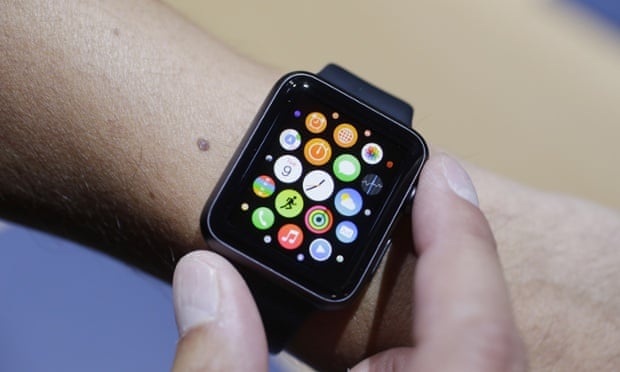
$189, creating a market worth $1.3bn. Analysts estimate the Apple Watch should add about
$10bn to the company’s revenues this year.Photograph: Marcio Jose Sanchez/AP
Simple maths suggests Apple will crash through that if it gets anywhere near
the middle of analyst estimates of about 22m in the first year. Estimates are
that the watch will add about $10bn in revenue, and an unknown amount of profit,
during 2015.
Neil Cybart, a former stock analyst at investment bank Keefe, Bruyette &
Woods, who has set up his own company, Above Avalon, to analyse Apple, says
Huberty is one of the more bullish on it. “[Her] theory about Apple products
serving user needs one-third of the day, but that it can increase to 75%, is
maybe the most important takeaway from the note and I think it essentially
describes Apple’s future,” he says.
Apple has often faced critics, but time and again it has proved them wrong.
When Steve Jobs launched the colourful iMac computer designed by Ive in May
1998, Apple was a deadbeat in the PC market, with about 3% sales share. The iMac
helped revive it. When Jobs unveiled the iPod in October 2001, the first comment
on a gadget site was that it had less storage than existing players, and no
Wi-Fi connectivity, making it “lame”. More than 400m have been sold. Microsoft’s
Steve Ballmer laughed at the iPhone in January 2007; Apple has trounced
Microsoft in the mobile market. Though the iPad has seen sales begin to shrink,
Apple is still by far the biggest vendor in that market, and now aims to sell
the tablets to businesses through a deal with IBM. And in the final quarter of
2014 its iPhones outsold Samsung’s smartphone range, giving it a new high of 15%
of all mobile phone sales.
The real question is whether the watch can become an unstoppable money-maker
like the iPhone rather than a shorter-term fizz like the iPad – which
nevertheless generated $27.8bn in revenue in 2014.
Ben Thompson, who runs his own Stratechery consultancy, thinks so: “The
biggest initial benefit of the watch will be the addition of far more ‘small
conveniences’ than most people expect (and, on the flip side, the removal of
small annoyances),” he notes. Cybart points out that Apple has long been valued
below other competitors based on its profits: it trades on a price-earnings
ratio of about 10, compared to 17 for many tech companies. “The overall [stock]
market has a market cap of $19tn, so finding $250bn is not an impossible task,”
Cybart says. “There is nothing technically stopping it reaching $1tn.”